The surface of the desk is a controlled chaos of prototypes, lab reports, and user feedback summaries. A sleek, charcoal-grey compression suit made of a material that feels unnervingly alive sits next to a set of vials containing what looks like artisanal sand, labelled 'Chrono-Stack.' A dossier on a coach specializing in geriatric powerlifting is weighted down by a device that promises to measure your metabolic flexibility from a single breath. This is the physical manifestation of the wellness industry's relentless churn—a torrent of hope, hype, and hardware that lands on our desk for vetting.
Our job at Codex is to sit calmly in the middle of this hurricane. We are the filter. For every hundred products, studios, or practitioners that clamor for attention, promising to optimize, bio-hack, or transcend, perhaps one offers something genuinely new. Not just a novel marketing angle or a prettier interface, but a fundamental shift in efficacy or approach. The rest is noise, and the noise is getting louder.
What's happening
The paradox of modern wellness is that having more choice has not made us well. It has made us anxious. Consumers are drowning in a sea of unsubstantiated claims, AI-generated meal plans, and influencers peddling powders with dubious provenance. The barrier to entry for launching a wellness brand is now astonishingly low; a compelling narrative and a slick Shopify template can create the illusion of authority overnight. This has led to a crisis of trust.
Simultaneously, the user is becoming more sophisticated. Years of tracking steps, sleep, and heart rate have created a baseline of data literacy. People are beginning to ask better questions. They are moving beyond 'what' a product does to 'how' it does it, and 'why' it's better than the alternative. They are less interested in generic promises and more interested in personalized protocols that deliver measurable results.
This convergence of market saturation and consumer sophistication creates the essential need for a curatorial layer. It's no longer enough to just list options. The new mandate is to verify, contextualize, and match with precision. We’re moving from a marketplace of goods to a marketplace of outcomes, and that requires a far more rigorous approach to what—and who—gets through the door.
Why it matters now
The Global Wellness Institute (GWI) valued the wellness economy at $5.6 trillion in its last major report, with projections suggesting it's well on its way to $8 trillion by 2027. This staggering figure attracts not just innovators, but opportunists. The financial incentive to cut corners, fudge data, or simply lie is immense. We see it daily in our vetting queues: coaches with credentials from non-existent universities, supplements with 'proprietary blends' that hide minuscule active ingredient levels, and tech that measures vanity metrics while ignoring physiological reality.
This isn't just about wasted money; it's about the erosion of potential. Every month spent on an ineffective training program or following bogus nutritional advice is a month of progress lost. The stakes are high, particularly as the conversation shifts from fleeting aesthetics to long-term healthspan and performance longevity. Making the right choice matters more than ever, and making the wrong one is more costly than you think. Our mission is to de-risk that choice.
Curation isn't about finding the best of everything; it's about finding the right thing for a specific person.
On the Desk
Our vetting process is multi-layered, moving from initial discovery and data-crawling to direct engagement and, for our highest tier, in-person verification. Here are four examples currently on our desk that represent the frontiers we're exploring.
A Coach: The Geriatric Performance Specialist
We're tracking a new archetype of coach, one who dismisses the gentle, 'anti-aging' tropes of traditional senior fitness. A prime example is Dr. Elias Vance, a kinesiologist whose client base consists almost exclusively of individuals over 65. His methodology isn't about maintaining mobility; it's about building raw power, improving VO2 max, and training for specific performance goals. His 72-year-old clients aren't doing water aerobics; they're on structured deadlift programs and training for Hyrox competitions. Vance's approach combines strength and conditioning principles from elite athletics with a deep, clinical understanding of sarcopenia, hormonal changes, and the aging nervous system. This represents a powerful shift from treating aging as a disease to be managed to viewing it as a new stage of athletic potential.
A Studio: Metabolic Conditioning Labs
Boutique fitness is fragmenting into hyper-specialized niches. Moving beyond HIIT and yoga, we're seeing the rise of studios that function more like human performance labs. 'Soma Labs' in Berlin is a prime example. An initial membership consultation involves not a tour of the gym, but a full metabolic workup: resting metabolic rate (RMR), VO2 max testing, and optional continuous glucose monitor (CGM) integration. The programming is built around improving metabolic flexibility—the body's ability to efficiently switch between fuel sources. Workouts aren't just 'hard'; they are precisely calibrated to elicit specific physiological adaptations, whether it's a Zone 2 endurance session to build mitochondrial density or a glycolytic capacity workout to buffer lactate. It’s for the data-driven individual who wants to train smarter, not just harder.
A Product: Mycelium-Based Recovery Wear
Smart apparel has so far been a story of embedding sensors into fabric. A new wave of material science is flipping that script, focusing on the inherent properties of the fabric itself. We're currently testing a recovery suit from a Swiss startup called MycoWear. It's woven from a proprietary textile derived from mycelium, the root network of fungi.
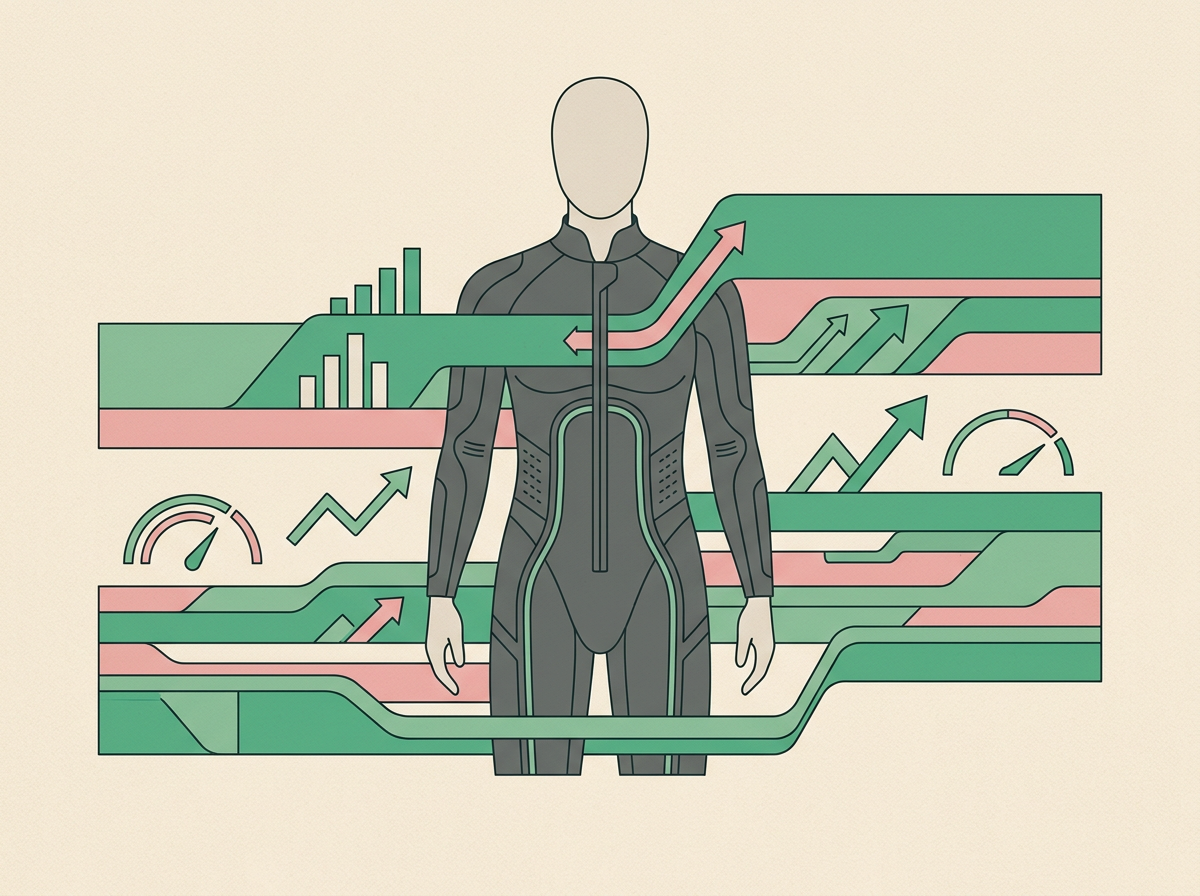
a minimalist charcoal grey recovery suit on a mannequin
The company claims the unique cellular structure of the mycelium fabric creates a microclimate against the skin, passively regulating temperature and humidity to accelerate recovery post-exercise. It's not 'smart' in that it doesn't have a battery or Bluetooth, but it is 'intelligent' in its biomimicry. It feels less like tech and more like a second skin.
- Verdict: A fascinating application of biomaterials, but clinical evidence for its specific recovery claims is still forthcoming. Feels incredible to wear, though.
- For: The recovery-obsessed athlete who has already optimized their sleep, nutrition, and cold-plunge routine.
- Price: €€€€ (est. €450-€600 for a full suit)
A Supplement: Chrono-Adaptive Nootropics
The supplement industry is slowly moving away from the 'one-pill-fits-all' model. We're looking at 'Momentum', a nootropic system designed around circadian biology. It’s not a single formula but a three-part daily stack: a morning blend to support the cortisol awakening response, a midday formula to sustain focus without over-stimulating the adrenals, and an evening blend to aid neural detoxification and sleep onset. The approach is about working with the body's natural rhythms, not against them. Instead of just a blast of caffeine, it uses timed adaptogens, mitochondrial support, and precursors for neurotransmitters like GABA and serotonin. It’s a systems-thinking approach to cognitive enhancement.
- Verdict: A logical, sophisticated evolution in the nootropics space. As with all supplements, individual mileage will vary significantly.
- For: The bio-curious professional looking to move beyond brute-force stimulants for a more holistic approach to their daily energy.
- Price: €€€ (est. €120/month supply)
The most effective wellness tool is discernment. The second most effective is a coach who already has it.
What this means for you
This glimpse into our process isn't a directive to seek out mycelium bodysuits or geriatric powerlifters. It's an invitation to apply the same critical lens to your own wellness choices. The underlying principles are what matter: look for personalization over generic claims, measurable outcomes over vague promises, and qualified experts over charismatic influencers. The trends we've highlighted—longevity, metabolic health, advanced recovery, and circadian alignment—are powerful, but only when applied correctly to the right individual.
You don't need to build your own vetting department; that's the service Codex provides. Our AI intake is designed to translate your specific goals, history, and preferences into a single, targeted match, cutting through the overwhelming noise of the market. Whether you're seeking one of the new breed of performance-oriented coaches or a specialized studio that aligns with your data-driven mindset, our verification tiers provide a crucial layer of trust and transparency. You can browse our curated selection of vetted products and see our full reviews at Codex /vs/reviews.
Verdict
The future of wellness will be defined not by the accumulation of more things, but by the precision of fewer, better things. As the industry grows more complex, the value of a trusted, human-led filter has never been higher. The most important trend for 2027 and beyond won't be a product or a service, but the simple act of discernment.
FAQ
How does Codex verify the coaches and studios on its platform?
Codex uses a multi-tiered system. 'Crawled' profiles are algorithmically identified, 'Claimed' means the provider has confirmed their details, and 'Verified' involves a rigorous human-led process, including credential checks, interviews, and for our highest tier, in-person evaluation.
Are the products and coaches mentioned in this article available on Codex?
These are examples of what we are currently vetting. Once they pass our verification process, they may be listed. You can find our current selection of verified coaches, studios, and products via our /intake or by browsing the respective sections.
What is a 'geriatric performance specialist'?
This is an emerging coaching specialty focused on applying principles of elite strength and conditioning to an older population (typically 60+). The goal is not just to maintain function but to actively build strength, power, and athletic capacity later in life.
How can I find a coach or studio that's right for my specific goals?
The best way is to use the Codex /intake. It's a short, AI-powered questionnaire that analyzes your goals, lifestyle, and preferences to provide a single, highly-personalized match from our pool of verified providers, saving you hours of research.